

Press Release
Hyundai E&C Sets Out to Secure Key Infrastructure Technologies for Carbon Neutrality
■ Builds Large Scale Carbon Transportation Infrastructure Through the Development of Integrated Process Design Technology Linking CO2 Pretreatment, Liquefaction, and Loading and Unloading Operations
■ Enhances Competitiveness in CCS Plant Design by Advancing Engineering Based on Data from Demonstration Plant Design and Operations
■ Pursues Expanded Application in Domestic and International Carbon Transportation Hub Projects Through Design Technology Linking Storage Tanks, Terminals, and Ports
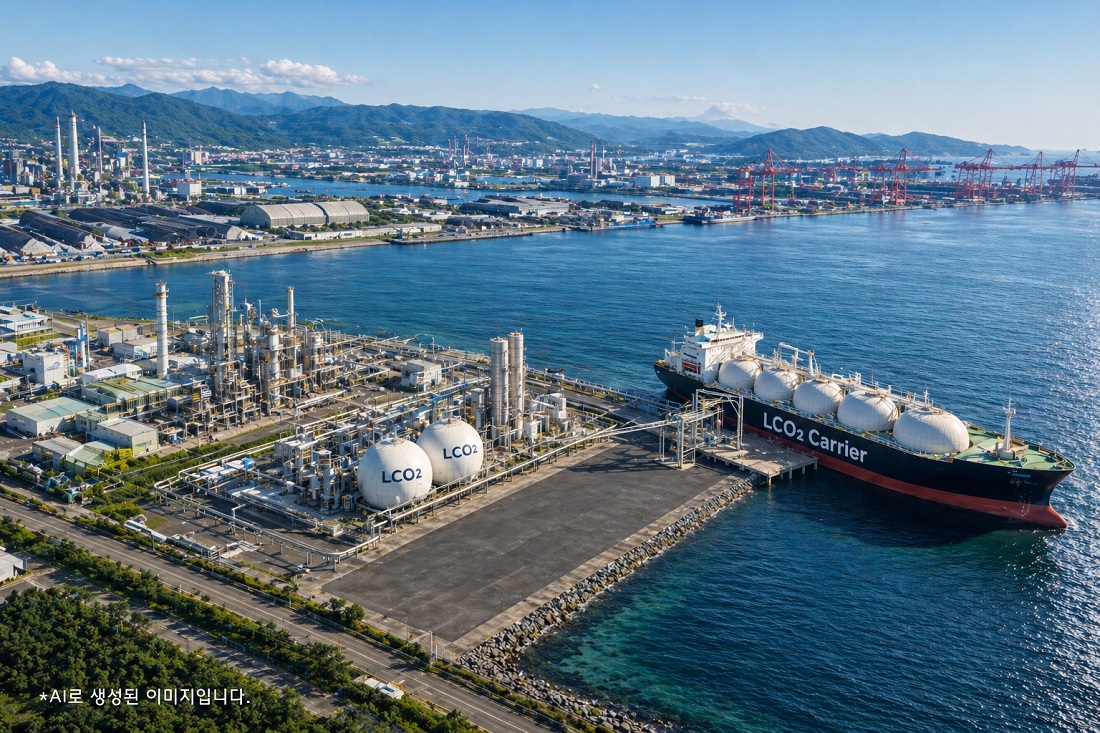
CCS Hub Terminal (AI-generated Image)
Hyundai E&C is strengthening its competitiveness in CCS technology for the carbon- neutral era by participating in the development of core infrastructure technologies for the liquefaction and transportation of carbon dioxide captured at industrial sites.
Hyundai E&C announced on Friday, the 3rd, that it is participating in the government-funded project titled “Demonstration and Development of CO2 Pretreatment, Liquefaction, and Bunkering Hub Technology for Multiple Emission Sources,” led by the Ministry of Climate, Energy, and Environment. The project aims to develop integrated infrastructure technology capable of purifying carbon dioxide captured from various industrial sites to high purity, converting it into a liquid state, and then storing and transporting it.
In particular, as the project focuses on developing core technologies for CCS hubs to be established primarily in industrial complexes and ports, it is expected not only to reduce dependence on foreign technology through the localization of technologies for the large-scale liquefaction, storage, and maritime transport of carbon dioxide, but also to strengthen the technological competitiveness of Korea's carbon-neutral infrastructure.
For this project, Hyundai E&C is responsible for designing the CO2 liquefaction process and providing integrated engineering that links pretreatment, liquefaction, and loading operations. The company plans to advance its process optimization technologies based on design and operational data from the demonstration plant, and to accumulate the engineering capabilities to apply these advancements to demonstration plant design, thereby strengthening the design competitiveness required for the construction of large-scale CCS hubs.
In addition, the project plans to develop design technologies that integrate liquefied CO₂ storage tanks, terminals, and port infrastructure, thereby establishing an engineering framework applicable to domestic and international CCS hub and carbon transport infrastructure projects.
Major institutions and companies from industry, academia, and research, including the Korea Institute of Advanced Technology, the Korea Institute of Industrial Technology, Seoul National University, Dong-A University, Hyundai Motor Company, Hyundai Steel, Hyundai Glovis, HD Korea Shipbuilding & Offshore Engineering, and GS Caltex, are participating in the project. The participating organizations plan to demonstrate the entire process, from carbon dioxide capture through storage, transportation, and utilization, to verify its commercial viability.
A Hyundai E&C official stated, "Infrastructure for the safe and efficient storage and transportation of carbon dioxide is a key foundation for achieving a carbon-neutral society," adding, "Through this project, we will advance our CO2 liquefaction and hub infrastructure design technologies and continue to strengthen our competitiveness in domestic and international CCUS projects."
Meanwhile, Hyundai E&C has been strengthening its competitiveness in the design and engineering of large-scale CCS infrastructure through a range of research and development projects. These include the front-end engineering design (FEED) for the CCS demonstration project utilizing the Donghae Gas Field - Korea's first commercial-scale CCS project - as well as research on CCS utilizing offshore oil and gas fields in Southeast Asia and the development of the world's first CCS technology based on concrete floating structures.
