

Press Release
Hyundai E&C Leads the Way into the Era of Sustainable Aviation Fuel (e-SAF) with Carbon Conversion Technology
■ Full-Scale Development of Next-Generation Sustainable Aviation Fuel (e-SAF*) Production Technology Through Participation in the Ministry of Science and ICT’s CCU* Mega-Project
···Collaborates with 10 Industry, Academia, and Research Institutions, Including Hyundai E&C and LG Chem, to Secure Demonstration Technologies for e-SAF Production Using Carbon Dioxide and Clean Hydrogen
*e-SAF (Electro-Sustainable Aviation Fuel): A next-generation sustainable aviation fuel produced by synthesizing clean hydrogen produced using electricity generated from renewable energy with captured carbon dioxide.
*CCU (Carbon Capture and Utilization): A technology that captures carbon dioxide generated by industrial processes and other sources, then converts and utilizes it as useful resources such as fuels and chemical products.
■ Strengthens Sustainable Fuel Production Capabilities Through Research on e-SAF Production Processes and the Development of Demonstration Plant Design Technologies
···Lays the Foundation for Commercialization Through Process Research to Improve Sustainable Aviation Fuel Production Efficiency and the Development of Demonstration Plant Design Technologies
■ Strengthens Competitiveness in the Energy Transition Sector by Expanding R&D Linking CCU Technology with Hydrogen and Renewable Energy Infrastructure
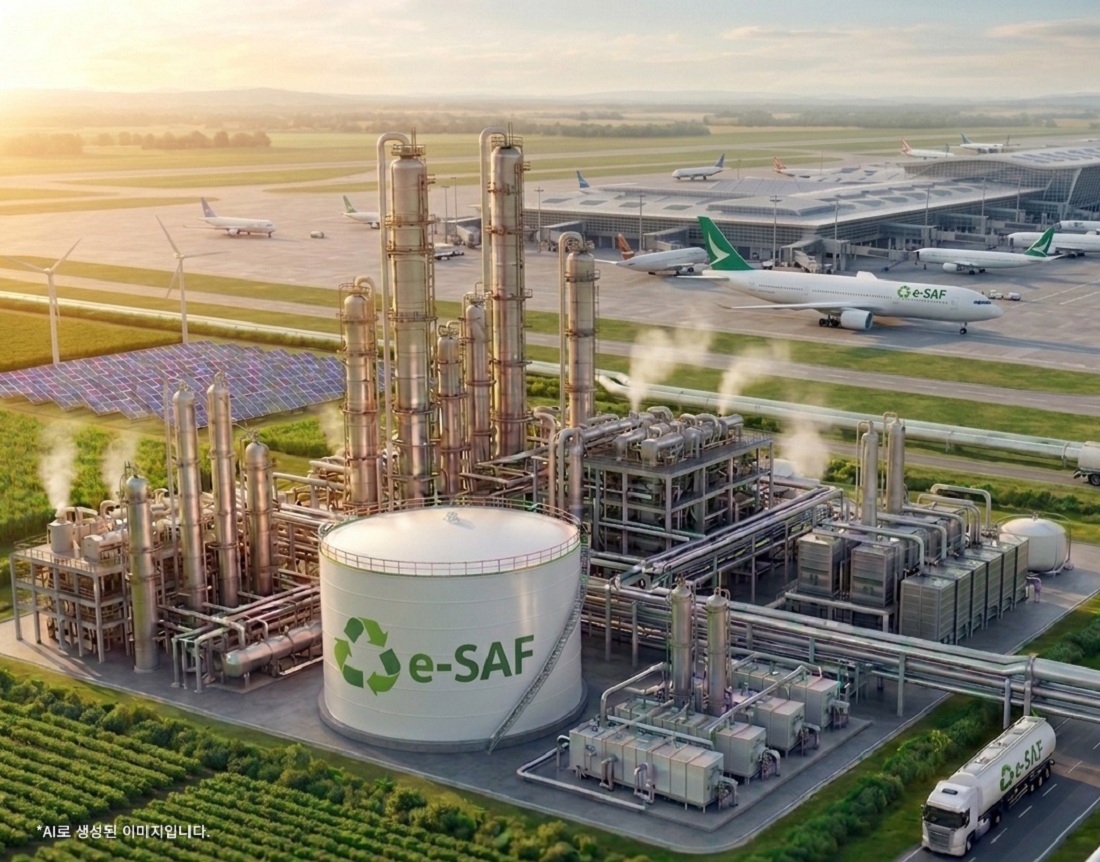
AI-Generated Image of a Sustainable Aviation Fuel Production Facility
Hyundai E&C is expanding the scope of its research in the energy transition sector by participating in the development of next-generation sustainable aviation fuel production technology.
Hyundai E&C was selected as a participating company in the government-funded project, “Development of e-SAF Production Technology through Carbon Dioxide Conversion,” led by the Ministry of Science and ICT. On Wednesday, the 24th, the company presented its project implementation plan together with participating institutions, including the lead institution, LG Chem, at the “CCU Mega-Project Kickoff Meeting” held at the Korea Institute of Energy Research in Daejeon.
The event was attended by representatives of the participating institutions, including Seo Yu-taek, Senior Vice President of Hyundai E&C’s HMG Construction Technology Institute; Shim Kyu-seok, Executive Vice President of LG Chem; and officials from the Ministry of Science and ICT. Participants shared their respective implementation strategies and detailed project plans.
The project, being pursued by the Ministry of Science and ICT as part of its Carbon Capture and Utilization Mega-Project, aims to demonstrate e-SAF technology that produces aviation fuel using captured carbon dioxide and clean hydrogen as feedstocks. A total of 10 industry, academia, and research institutions, including LG Chem and Hyundai E&C, are participating in the project. The consortium plans to progressively secure e-SAF production technology, from the experimental stage through the construction of a demonstration plant, as an alternative that is gaining attention for its potential to address the limitations in feedstock supply faced by conventional bio-based SAF.
Hyundai E&C will conduct research on the e-SAF production process using CO2 captured during the project, review the design of the demonstration plant, and provide technical support, thereby contributing to improved stability and the overall quality of the demonstration plant. The company will also use its research facilities to validate methods for improving production efficiency and jointly conduct research on advanced processes that convert CO2 into synthetic crude oil for use as sustainable aviation fuel. Through these efforts, the company aims to optimize process integration and improve product quality at the same time, while securing integrated process technologies suitable for future commercialization and laying the groundwork for the commercialization of sustainable aviation fuel production technology.
A Hyundai E&C official stated, “Through this project, we have laid the foundation for establishing an integrated technology system covering the entire sustainable aviation fuel production process by linking CCU technology with hydrogen and renewable energy infrastructure,” adding, “We plan to continue expanding R&D that integrates carbon reduction technologies, the hydrogen ecosystem, and energy infrastructure, while continuously strengthening our R&D capabilities in sustainable fuel production and energy transition.”
Meanwhile, Hyundai E&C is expanding its research and development in hydrogen, CCUS, and renewable energy, based on carbon dioxide capture technology and clean hydrogen production technology using water electrolysis. Building on these efforts, the company plans to expand the development and demonstration of energy transition technologies, including hydrogen, SAF, and nuclear power, while continuously strengthening its capabilities in sustainable energy businesses.
