

Press Release
Hyundai E&C’s Century-Long Ambitions Come to Life in a 45m Mega Graphic
■ Hyundai E&C Turns a Signature Structure on the Seosan Reclaimed Land into a Visual Chronicle of Its Corporate Journey of Challenge and Innovation
■ Precise Engineering and Design, from the Cylindrical Curved Surface to the Seaside Setting, Heighten the Structure's Visibility and Symbolism
■ An Aging Agricultural Facility Is Reborn as a Local Landmark and Becomes a Centerpiece of the Company’s Employee Heritage Tour
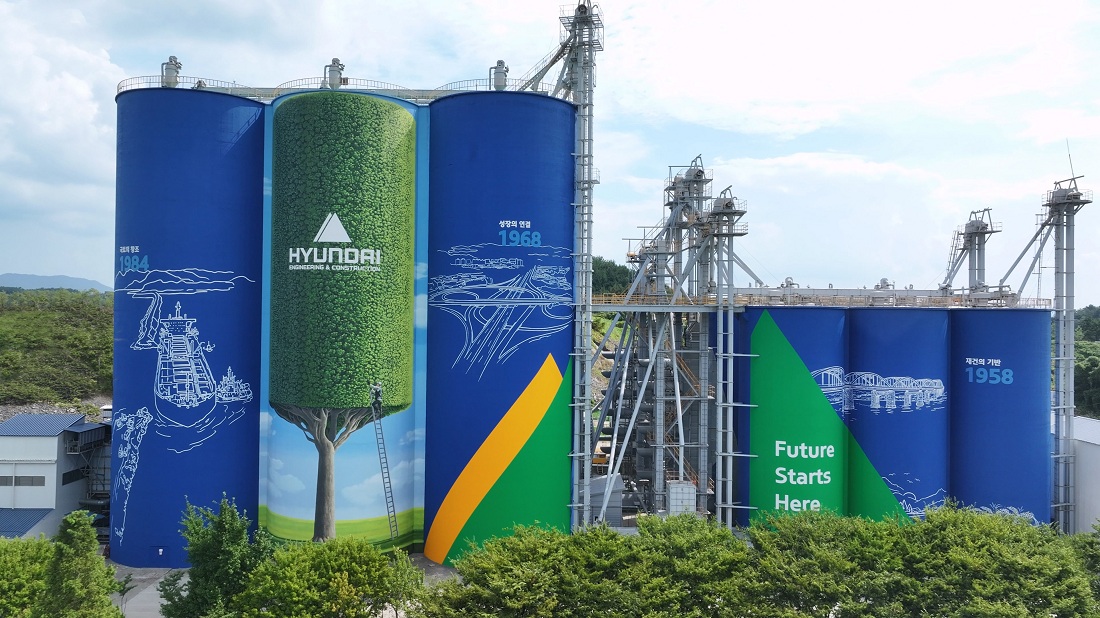
Hyundai E&C’s Rice Processing Complex in Seosan
Hyundai E&C has unveiled a monumental graphic on reclaimed land in Seosan, telling the story of the company's values and history.
The company announced on Nov. 6 that it has transformed the exterior of a silo at a rice processing complex (RPC) within Hyundai Seosan Farm in Buseok-myeon, Seosan, South Chungcheong Province, into a symbolic local landmark with a large-scale supergraphic design.
The RPC where the graphic was painted mills and processes rice grown on the Seosan reclaimed land. It consists of ▲six storage silos ▲six conditioning silos ▲a rice mill ▲a receiving room ▲a warehouse and other facilities. Most striking are the “storage silos,” which rise 45 meters, the height of a 15-story apartment building, and together can hold more than 20,000 tons of rice.
Conditioning silo: Used for temporary grain storage to regulate moisture content and temperature.
The Seosan reclaimed land is a large-scale national land development project in which Chung Ju-yung, Hyundai’s founding chairman, turned the sea around Cheonsu Bay into roughly 16,000 hectares of land. He believed that “land is the most precious legacy that can be passed down to future generations.” The reclamation project added 1% to Korea’s land area. It reflects the company’s spirit of challenge and its record of innovation, including a method of closing off the sea with an oil tanker, and it is still regarded as a signature achievement that embodies Hyundai E&C’s corporate philosophy.
Instead of merely refurbishing the aging rice processing facility, worn down by years of sun and sea winds, Hyundai E&C transformed it into a graphic landmark that reflects the historical symbolism and geographic character of the Seosan reclaimed land.
At the center of the massive storage silos, the company placed a towering tree rising from a green field. The remaining surfaces of the storage and control silos were filled with signature projects that tell the story of Hyundai E&C’s growth, set against a blue backdrop evocative of the sea. The design also incorporates the triangular motif and signature colors of Hyundai E&C’s corporate identity, reinforcing the company’s visual identity while allowing its brand story to unfold as a single, continuous chronology.
Particularly striking is the thoughtful layout, carefully tailored to the silos’ cylindrical form and 360-degree visibility. From Cheonsu Bay, where the Seosan reclaimed land was born, viewers can see line drawings of the restoration of the Hangang Bridge, a symbol of postwar national reconstruction, and of the construction of the Gyeongbu Expressway, which helped usher in an era of same-day travel across the country. From vantage points in Taean County, home to the HMG Driving Experience Center, and along Bunam-ro, where the Hyundai Mobis Seosan Proving Ground is located, the design reveals sketches of the Seosan reclamation project and of Seosan native cattle, which helped open a new chapter in inter-Korean cooperation. Together, these elements convey a message of harmony and prosperity. In addition, the views facing the Asan Training Center were designed to feature the UAE's Barakah Nuclear Power Plant, Korea's first overseas nuclear power plant project, and the 36.1km long mega-sea bridge, Kuwait's Sheikh Jaber Al-Ahmad Al-Sabah Causeway, to showcase Hyundai E&C's global prestige.
The project is also unusual in two other ways. Because the facility stores grain, the company chose paint to minimize harmful substances, and it kept the work to less than 10 weeks.
“As Hyundai E&C marks its 80th anniversary next year, we are proud to have given Seosan, a place that holds the convictions of our founding chairman, Chung Ju-yung, new life as a symbolic space where the company’s history and pioneering spirit live on,” a Hyundai E&C official said. “We will continue to raise both our corporate value and the region’s symbolic stature through a range of initiatives and content that draw on our brand heritage.”
Beyond the RPC, Hyundai E&C operates the Asan Memorial Hall, a former residence of its founding chairman, along with employee training and lodging facilities at Seosan Farm. The company also runs heritage tours for Hyundai Motor Group employees, turning the site into a venue for introducing new hires to the group’s history, values and corporate culture.
